Designing Something Blog Posts

Cultivating your email newsletter list

Of all the types of marketing that we do at Po Campo, email marketing is probably the most successful in terms of ROI. Our e-commerce conversion rate for newsletters is 1.49%, the highest of all our marketing efforts. Our newsletter subscribers may only account for about 4% of our website traffic, but over 8% of our conversions, so they’re active and engaged visitors too.

Building Your Newsletter List
We get about $17 in sales from each newsletter for every hundred people on our list. Naturally, the more people on our list, the more sales we can expect. That’s why growing the list is always a priority. Focus on growing your list organically rather than purchasing or trading lists so that it remains high quality, resulting in higher sale conversion rates.

The two most successful ways we build our newsletter list involve, unsurprisingly, giving things away for free.

1) Offering something irresistible. Try a couple offers (called a “lead magnet”) before figuring out what your customers like. Before offering a $50 gift card to one lucky new subscriber each month, we tried free content about tips for city biking and a free $5 on your first purchase. The bigger sweepstakes of a free $50 worked best for us. We get an average of 65 new sign-ups each month once we started this practice. Read more on lead magnets here.

2) We offer a free reflector pin (value of $5) in exchange for an email address at all of our events. Few people can resist the pin, plus they don it almost immediately and then other people ask where they got it from and are directed our way. We can get upwards of 200 emails a day at busy events.

Maintaining Your List
The obvious goal is to send people emails that they enjoy receiving so as not to unsubscribe. You’d think that sales/promotion emails are the best, but while those probably generate the most immediate sales, we have found general lifestyle topics, company updates, tips and how-tos to have the lowest unsubscribe rate.

Po Campo sends an email about every other week on Thursdays. Creating an email marketing calendar ahead of time reduces the “So what do we write about this week???” syndrome, which almost always results in boring emails. By creating a calendar, you can make sure that your sales are spread out throughout the year and that you are maximizing the content that you are creating elsewhere (e.g. for your blog or for Facebook). Our average open rate is 30.1% and click through rate is 6.9%, which are both above average (17.35% and 3.0% respectively, according to MailChimp benchmarks).

Discouraging Unsubscribes
About .6% of our newsletter list unsubscribes with each email. That’s not super high but of course I wish it were zero. Recently I did two things to curb the unsubscriber activity, or at least to not lose touch with them altogether.

1) An option to receiver fewer emails. I know sometimes I open my inbox and go on a major unsubscribe binge, removing myself from pretty much every newsletter just because I’m sick of receiving them and having to devote energy to them. Of course many of our subscribers unsubscribe because of a similar feeling, not that they don’t ever want to hear from us ever again but because we were just one more email that day.

Hoping that we could keep people subscribed if we gave them an option to receive fewer emails, I created a group in MailChimp called “Newsletter Types”with three sub-groups:

  • “All, including tips and how-to’s, event announcements, sales, and new product debuts”
  • “Just Sales/Promotions (about 6 times per year)”
  • “New Product Announcements (about 4 times per year)”

Now, when people go to unsubscribe, we allow them to update their profile and change their newsletter frequency preference.

2) Ask to connect another way. I think most of us have email fatigue and prefer interacting with brands on different mediums, like facebook or Instagram. On our unsubscribe confirmation page, we ask one last time if they would consider connecting with us on one of our social networks, so as not to lose touch with them completely.


I hope this inspires you to build and maintain a healthy newsletter list. Do you have strategies beyond what we’re doing to do so? Please share in the comments!

Ways to Finance your Small Business

How do you finance your small business? It’s a good question.

Unless you are independently wealthy, you are going to need money. An early mentor told me that I would need twice as much money and time to grown my business than I thought. I vividly recall thinking, “Not me!”, but she was right. In fact, I would say that it has taken four times as much money and time as I had thought. So learn from my mistake and plan for it.

A recent feature in Crain’s Chicago Business discusses the current state of small business financing, and it’s worth a read. Here’s my take on the different sources for cash.

1) Your own money. Plan to use pretty much all your savings over time (guess who covers the cash flow crunches???), but try not to touch your retirement account, as that would be irresponsible.

2) Friends & Family. Nobody really wants to do this, but you’ll probably have to, as you’ll run out of your own money at some point. I only asked people for money who met three criteria: 1) Had money that they didn’t really need to survive; 2) Knew me and trusted me; 3) Liked the idea of supporting an entrepreneurial venture. A handful of former colleagues and close family members met this criteria, and they all gave. I asked for a loan rather than an investment; it seemed simpler and better fit the spirit of the request, as people wanted to help me more than get rich off my company.

3) Microloans. Non-profits like ACCION lend to small businesses that would be refused by traditional banks for various reasons. The loan amounts tend to be smaller (under $50,000) and interest rates are higher, but they are accustomed to working with non-bankable businesses, and therefore are much more understanding and creative in their approach. I have had two loans with ACCION and found the process to be painless and almost enjoyable, as I really feel like they are rooting for me.

4) SBA Loans. Banks don’t want to lend to small business: too risky. The government’s Small Business Administration (SBA) will guarantee a bank’s loan to minimize its risk. These are almost easier to get as a start-up than as a young business, because if you’re the latter, you’ll need to show positive cash flow (i.e. profit), have collateral and have good business credit, most of which you probably won’t have. I’ve been turned down by seven banks, despite having year-over-year growth, so I haven’t really found this to be a doable option. Plus, each application takes hours and hours of paperwork so it can feel like a major waste of time if it doesn’t work out. Not to mention that the bankers will treat you like a big loser, which sucks.

5) Crowdfunding. Kickstarter, Indiegogo, and the like, is probably where new product companies go for the first round of capital nowadays. It make sense, because you can pay for your first production run AND get your first customers. Some people keep going back to the crowdfunding well for more money, but it seems like you’d eventually hit a point of diminishing returns. Po Campo did a Kickstarter campaign for our Bike Share Bag in May of 2013. It was successful, but was so much work that I can’t imagine it would pay off as a longterm strategy.

6) Alternative sources. These run the gamut and some can be kind of loan shark-y, so be careful. A common method of funding is to pay back a loan with a portion of sales, plus interest. You typically can get the money quickly, but if you can’t pay it back quickly, then it can turn out to be incredibly expensive. I think it’s best for companies that sell a lot daily, like a restaurant. Online sales take a long time to build up so this isn’t a good option if you’re just getting going. Paypal Working Capital offers this for existing customers, which I haven’t tried yet but might in the future. Bolstr is a Chicago company with a similar approach, using investors’ money without giving up equity. We did a program with them last year. I thought it was a lot of paperwork for just $10K, but could be an option for you.

7) Angel Investors. Typically this is the next step in major funding (think $100K+) after the friends and family stage. A characteristic of angels is that will buy into your vision and will offer guidance and mentorship to get to the next level. This isn’t a philanthropic donation however. They will take a share of your company and will expect to see a return on their investment, usually when you sell your company down the road, or during a future fundraising round. Po Campo has no investors, but I’m looking. You can’t just look angels up in the phone book, so it’s lots of networking to find someone that’s a good match.

8) Venture Capitalists. VCs focus on high growth companies, which pretty much isn’t you if you are making a tangible consumer product. There are exceptions of course, but high growth companies are in the tech field, as this interview with venture capitalist George Deeb succinctly explains. VCs get all the attention in the media, but this is probably your least likely source of capital.


As you can tell, I’ve tried most things. None of it is very pleasant but seems to be just a fact of life of a small business. I’d love to hear your take on the different methods in the comments.

Creating an Environment for Work/Life Balance

One of the major draws of starting my own business was to create a work environment where people like me could thrive. I craved an atmosphere that honored introvert tendencies (enough with the constant collaboration and open floorplans already!) and that trusted its colleagues enough to let them structure their work days in a manner that best suits them.

Now I have that! At Po Campo, we each have our own space that gives us a place to focus and get work done. We have a flex schedule that allows for remote working, so you can structure your life how you want it.

An unexpected outcome of this arrangement is that work doesn’t feel as urgent. We agree at the beginning of each week what needs to be done that week to keep us moving towards our business goals and then each person is responsible for completing their portion of the tasks. We check in with each other daily, but questions can take a little longer to be answered since you lack the immediacy of impromptu conversations, so you learn to be patient.

Going from the fast-paced environment of a design consultancy to the more easy-going environment of Po Campo took some getting used to for me because at first I worried we were slackers. Now I appreciate that we still get as much work done (if not more), just with a lot less stress. I’ve learned that treating work with less urgency does not mean you care about it any less, it just helps you fit it in to the rest of your life better, which in many ways makes you value it more. For the first time, an actual work-life balance feels attainable.

Removing Gender Bias from Job Postings

In 2013, I attended the National Women’s Bicycling Forum in Washington D.C. and sat in on the panel discussion entitled “Insight from the Industry: The Keys to Closing the Gender Gap”. In discussing different ideas for inclusion of women in the biking industry, Julie Harris from REI talked about how her organization changed their interviewing process after realizing it was predisposed to favor males. Their former process used to include questions that required applicants to rate themselves, but after learning that males tend to rate themselves higher than women do, regardless of ability, they decided to remove this practice from their employee selection process.

I was impressed that REI took responsibility for their process and did not fault women for answering the way that they did, as I often feel like the solution to problems like this is, “women just need to learn to be more confident!”. (Why never “men need to learn to be more modest!” WHY!?) I find psychology to be so insightful, yet so rarely do I hear about companies learning from its lessons and changing the way that they do things. Bravo REI!

Fast forward a year and a half and I’m toiling with the idea of adding a new person to my team. I started with writing a job description to make sure I knew exactly what I wanted this person to do (Simply “Help Us!” doesn’t work – I tried). I made a list of everything I wanted the person to do. Then I made a list of all the skills I wanted the ideal candidate to have, and then I made a list of certain personality traits that I think this person should possess to fit in with our culture. Much to my chagrin, in doing this exercise, I caught myself drafting a job posting that favors men over women.

There are very few people that would be able to “check the box” for all of these things, and almost certainly no one that would be willing to do it for the what I can pay. Rather, I was hoping that applicants would get the idea of what I was looking for, craft their cover letter and resume accordingly, and then I could pick who I thought was closest to the ideal candidate. Seems logical, right?

Similar to the illusory superiority cognitive bias that men possess and that REI corrected for, I am also aware that women tend to apply for jobs only when they meet 100% of the criteria, whereas men apply when they meet 60%. (This statistic is from a much-quoted research study from Hewlett-Packard). Since I already knew that there was likely no person that could fulfill 100% of the criteria I outlined in my job posting, wasn’t I biasing the application process towards men from the outset?

recent blog post on the Harvard Business Review by Tara Sophia Mohr debates the common conclusion that this disparity in behavior between men and women exists simply because women are not confident enough. Her study showed that the main reason men and women do not apply for a job is because they don’t want to waste their time and energy when they don’t have a decent shot at it. As Mohr succinctly concludes, “what held them back from applying was not a mistaken perception about themselves, but a mistaken perception about the hiring process,” and goes on to say, “For those women who have not been applying for jobs because they believe the stated qualifications must be met, the statistic is a wake-up call that not everyone is playing the game that way. When those women know others are giving it a shot even when they don’t meet the job criteria, they feel free to do the same.”

Equipped with this knowledge, I revisited my job description and job posting and rephrased some things to level the playing field somewhat, such as changing the standard “Required Qualifications” to “Desired Skills & Experience”. I also tweaked the description of my ideal candidate to include being “comfortable with challenging assumptions” to give her permission to break the rules a bit, to apply even if she doesn’t feel qualified. I just hate the thought of the perfect candidate being out there somewhere but not applying because she doesn’t want to waste her time, and I believe these small changes will make a difference.

Have you encountered gender bias in your workplace? In what way and how have you addressed it? I’m very curious to know! Please leave comments below.

How to Make a Good Soft Goods Tech Pack

Have an idea for a bag design and want to get quotes from a soft goods manufacturer? One of the first things they will ask you for is the “tech pack” for your design, so they can make a sample of the bag to see how complicated/time-consuming it will be to produce. The tech pack generally consists of three things:

1) Sketches of the design concept with material call-outs. For simple designs, this can be a simple three-quarters view sketch that shows the front, side and top. Additional sketches may be needed to show how a pocket opens or other such details. Be sure to include stitch lines.

Example of Bag Sketch
Example of product sketch with material call-outs

2) Orthographic / elevation drawings with dimensions. I take pride in providing our suppliers with very detailed drawings that leave little room for guesswork. This forces me to think through all the bag’s details in advance of sharing the concept with the supplier, which in turn helps the factory produce samples quicker and easier.

Example of Bag Orthographic
Example of Detailed Orthographic Drawings

3) Bill of Materials (BOM). Again, the more detail you can provide here, the better off you will be. The factory may use other materials for the initial sample but it will always be clear what you are intending for the final product.

Example of Detailed Bill of Materials (BOM)

How long should the tech pack be?
Most of my tech packs are three pages long, one page for each item above. More complicated designs may require additional pages to explain some of the details and features. There is no limit to how many pages you can include, but in my experience, the more concise you can make things, the better.

What software do you use?
We do all of our technical drawings in Illustrator. I’m quite reliant on using its “Smart Guides” feature to quickly align objects, to find intersections and anchor points and to see measurements as I draw. I first draw everything full-size on a large artboard and then scale it down proportionately to fit on a letter-sized piece of paper. There is also an Illustrator CADtools plug-in that helps with dimensioning and material call-outs.

Besides the orthographic drawings, we make our BOM in Excel and then share it all with our factory as a multi-page PDF.

How do you show updates and revisions?
After you receive your sample, you’ll probably want to make some revisions. I’ve found the best way to do this is to clearly mark everything that is changed on the next version of the tech pack so that the sample maker can quickly see what needs to be done differently.

Do you have to create a pattern?
No, thankfully in bag design, you do not have to create the pattern. The sample maker figures this out based on your tech pack.

What if I’m unsure about what materials to spec?
If you don’t specify the materials, the factory will tend to use either what they have lying around or what they can get at a good price. In other words, they’ll use what’s easiest for them and not necessarily what’s best for your design. Therefore, I always try to specify something. If you have a sample of a material but you don’t know what it is called, send the sample and ask them to find something similar and include the “Sample Fabric A” in the BOM until you have a better name for it.

Is collaboration lost if you are being so “prescriptive” and “detailed”?
While we designers revel in concept development and iterative prototyping, you have to remember that factories make money from production, not sample making, and therefore every effort to streamline the sampling process is greatly appreciated. Expect collaboration to take the form of factories offering suggestions on how to make your design more efficient to produce.

It took me awhile to learn this. My first job was making bags for Arctic Zone, whose biggest customer was Wal-Mart. We constantly made samples without nary a grumble from the factory because they knew a huge order was the pay-off. With small companies, like Po Campo, there is no assurance of a huge order, or any order for that matter, at the end of the sampling process, so factories are much less interested in endless sampling. I have found working relationships best if we can get to the final prototype within 2-3 rounds of sample making.

Do you prepare the tech pack the same for both domestic and overseas manufacturers?
Yes. With native English speakers, there is less risk of things getting lost in translation, but I have found the importance of a concise tech pack to be the same regardless of where the factory is based.


Any other questions? Please leave in the comments below. Do you do things differently? I’d love to hear from your experience, as I’m largely self-taught.

How to Use Google Trends to Select Keywords

I was recently updating the product descriptions, page titles and meta descriptions on Po Campo’s e-commerce site to be more search engine friendly.

The first thing I did was research keywords in Google’s keyword planner to find product types and descriptions with the coveted combination of high search frequency and low competition. Po Campo makes a niche product, which means I don’t expect people to search for products like ours a thousand of times per month. Rather, I look for words or phrases that are searched for about a hundred times per month and have a “medium” competitive rating.

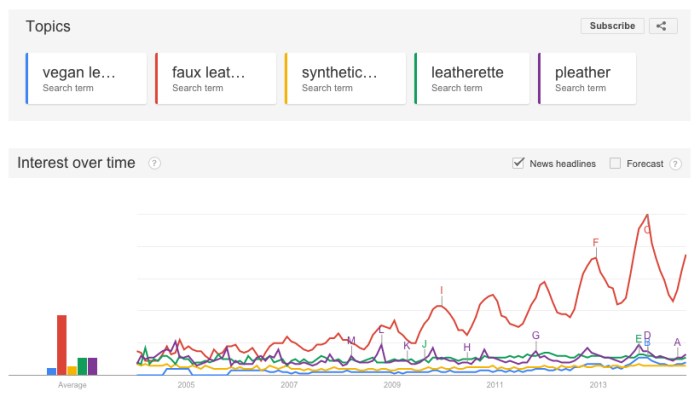
Occasionally you find yourself with a few options of keywords that describe the same thing and are similarly appealing from a search frequency and competition perspective. One example of this for me was how to describe the synthetic leather on our bags. “Vegan Leather”, “Faux Leather”, and “Synthetic Leather” are all searched for a decent amount of times and have a low to medium competitive rating. So which should I use in our product descriptions? A mix or stick to one? To answer that question, I checked with Google Trends.

GoogleTrends

By comparing similar descriptions for fake leather, I learned that “faux leather” is clearly trending, so I updated all of our product descriptions to include that phrase.

With all else being equal, try using Google Trends to understand where the popularity of certain keywords is going so that you don’t choose keywords that are going out of favor. Plus, it’s fun!

The Value of Offering a Lifetime Guarantee

Po Campo offers a lifetime warranty on its products, which is kind of unusual for a fashion oriented brand. We started doing that in early 2013, despite not drastically changing our products to go from 3 year warranty to lifetime warranty. Does that seem odd? Keep reading.

Like must industrial designers, making quality product is important to me. Nothing upsets me more than the thought of bringing crappy things into the world that end up in a landfill after a few months. But how do you know you’re making quality products? This is trickier than I thought it would be.

Since the word “quality” is subjective, defining and specifying it isn’t straightforward, especially in soft goods where there a lot of places to cut corners or make substitutions. With every production run, I learn something new about what to source or specify because something new goes wrong. And often times what goes wrong is not apparent at first, only when products are used a lot and don’t hold up. Then you have justifiably angry customers, which upsets me because I feel I owe my customers more than that.

What I realized last year was that even though it bummed me out to hear about problems with the bags, we were really dependent on learning about the issues so we would know what to fix on the next production run. Some people will tell you if they’re having problems on their own volition, but a lot of people won’t tell you and will instead just think you make junky stuff, which is the last thing I want to happen.

I thought to myself, “How can I find out about every and all problem our customers are having with our products?”. Then it hit me: a lifetime warranty!

Since implementing the lifetime warranty, the number of returns and emails have definitely gone up, which is exactly what I wanted to happen. One or two issues that I thought were minor or rare turned out to be more common than I had expected, so we made fixing them a priority.

Now that I’ve accepted that everything is pretty much a work in progress, I’m focused on constantly iterating to make all our bags better and better. Eventually we will get to the point where returns are few and far between. We’re working towards that.

If you make your own products, how do you learn about people’s experiences with them? What kind of warranty do you offer, and why?

How To Get Your Product Into Stores

It’s common nowadays to launch your product on Kickstarter or a Shopify store, but neither of those options were really around when I launched Po Campo in 2009. Getting our bags in physical stores was our main sales strategy when we were starting out.

That first summer, Po Campo was available in about a dozen stores in Chicago, which was a good start and we really have just built on that. One of the most common questions I get is “how do I get my product in stores?”. Well, this is how I did it!
http://youtu.be/Z26m6ZjQAbA
 

Step One: Make a List of Stores to Approach
I made a list of about 20 shops that I thought Po Campo would be a good fit in, based on where I and my friends liked to shop, since we were my intended consumer. I also thought about which brands were complementary to Po Campo, in terms of style and pricepoint, found out where they were locally being sold and added those stores to the list. Small, independent shops are much easier to cold-call and get into than larger chains, so start there.

Step Two: Research
Before you start walking into stores, do some research on how to build out your sales program with wholesale pricing, minimums and terms. To find this information out, I asked store owners and other product companies about what they do. I have found people to be very helpful and forthcoming with this information, so don’t feel weird about asking. Specifically:

  • What is your wholesale price? This can vary by product category and industry. For bags like mine, the wholesale price is half of the retail price (this is called keystone).
  • What is your minimum opening order? Is there a minimum reorder? This is usually based on a quantity (e.g. minimum of 10 pcs) or a dollar amount (e.g. minimum of $500). Based on my research, I chose to do a minimum starting order of 6 pieces, so enough to make a decent Po Campo display but not too much to make it seem like a big commitment for a small shop, who doesn’t want extra inventory lying around with no place to store it. We don’t have a reorder minimum because we want our retailers to feel free to place special orders for customers.
  • What are your payment terms? The basic options here are:
    • Due on receipt (pay right away). The faster you can get paid, the better. Our first orders were pretty small (less than $300), so most shops were okay with starting out this way. You can use Square or PayPal to take credit cards right away; the ease of credit cards more than makes up for the cut the credit card companies takes, in my opinion.
    • Net 30 (pay in 30 days). This is pretty standard but I suggest doing a credit check before you give anyone product as it is practically impossible to get it back if they don’t pay. Old school credit checks require the store to first fill out a credit application, then you contact their references to see how good they are about paying on time. The process feels antiquated (although effective), so now Po Campo uses Cortera, which costs money but is quicker.
    • Consignment (pay when the product sells). Small shops love this because it is essentially risk-free for them but that puts all the risk on you, plus it is a pain in the butt to manage. Therefore, I wouldn’t even offer this option and focus your attention on stores with enough cash to buy the product outright.


Step Three: Build Your Materials
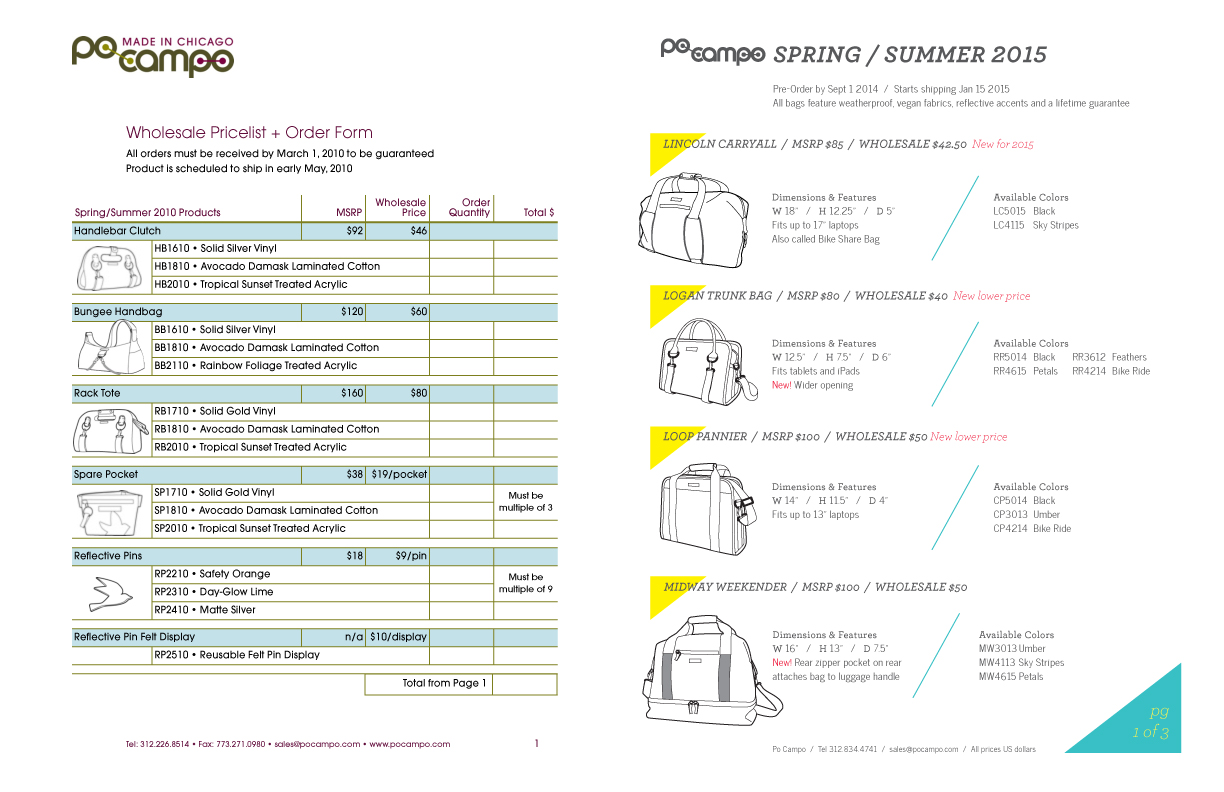
Put together a (preferably one page) line sheet with:

  • Product drawing or photo with item number, dimensions, brief description, color options (if any)
  • Retail and wholesale price
  • Minimum order amount
  • Order deadline
Older 2010 line sheet on left, latest 2015 line sheet on right

I’ve found that it is immensely helpful to have a sample with you, even if it isn’t perfect. Samples about 90% of the way there are good enough.

A lookbook or catalog is nice but not necessary when you are just starting out. At this stage, you are the best representation of your brand. Introducing your product in person does more to sell your brand than a lookbook ever could.

Step Four: Start Selling
You’re ready to start going door-to-door! This is great practice for honing your pitch and learning how to clearly communicate the most interesting aspects of your product/brand. Practice makes perfect, so don’t be hard on yourself if your first visits are clunky. Here’s what I did:

  1. Find the owner/buyer and ask for a few minutes of her time, or schedule a time to come back. You’ll really only need 5-10 minutes.
  2. In a few (rehearsed) sentences, tell her about your brand and why you designed the product the way you did. Let her play around with the sample, answer her questions, go over the items on the line sheet.
  3. If she seems interested, ask for the sale by saying something like “Can I get an order going for you?”. It may seem a little confrontational, but trust me, it’s necessary. Few people will just say, “This is great, I’ll take 10!”.
  4. Leave your line sheet behind, maybe with your business card stapled to it, so she has a concrete memento of your visit. Get her email address and send her an email later that day to thank her for her time and to confirm her order or suggest an order based on what you talked about.

And if she says she’s not interested? You have to train yourself to hear “not yet” whenever you hear “no”. Jot down why she said no (might just be timing or wrong color) so you know when to go back to her in the future. Then move on to the next store on your list.

Okay, that’s it! In some ways it feels like a numbers game, in that you’ll get a new customer for every 4 qualified stores (or whatever) that you visit. Try to make your pitch a little better every time by listening to questions people have and noticing what they are responding to, both positively and negatively.

Good luck and share your experiences!


3 Lessons From When a Big Break Went Bad

Po Campo exhibited at Outdoor Retailer for the first time in August 2011 and it felt like we were the stars of the show. Despite being in the back of a tent in a parking lot across the street, there was a flurry of traffic the whole time, with buyers from nationwide chain stores calling their colleagues on their cell phones, saying “You gotta get over here and see this bag line!”.

I thought this was my big break. Finally, we were getting interest (and orders!) from large retailers, dramatically increasing our sales to the point where I could not only start paying myself but maybe get a little office and a little staff, the whole bit. The buyers said they needed the new product within five months for a spring launch and I said, “Sure, no problem!” even though I knew this was actually a big problem, since I wasn’t sure how I was going to make the bags. We had recently decided to split ways with our existing manufacturer and hadn’t lined up a new one yet. 

The next few months were the most stressful of my life. From having to come up with $50,000 in two weeks for the factory’s downpayment to taking a call on Christmas Day to learn that the bags would be months late, to paying out the nose to get bags made locally to meet our January order commitments, to finally receiving the bags from China – in April – only to learn that there weren’t all perfect. All those big customers I was so thrilled to line up dropped my product line and rather than propelling Po Campo forward, the whole episode set us way way back. I hope I will never have to go through that again

And I hope you won’t either! Here are a few lessons that I learned so that you won’t repeat my mistakes.

1) Rushing manufacturing leads to problems. You may be able to pull all-nighters with your local team to hit a deadline, but this just doesn’t seem to work with manufacturers, especially ones on the other side of the world that you have a short history with. There are just way too many things that can go wrong and your business will bear the brunt of it. I think it’s better to communicate delays with your customers (or not take the orders in the first place) than to force manufacturers to go beyond their comfort zone and try to do the impossible. We now agree on a development and production schedule with our manufacturer that we are both comfortable with and don’t rush it.

2) You do dumb things when you’re desperate. I was feeling so rushed to get manufacturing started that I shelled out for a big downpayment before seeing any good samples from the factory. I know, very scary – and stupid! But I was feeling desperate. The factory said they needed the money to know that I was serious before getting started, which is fair enough, but I needed good samples to know they were serious about making my product. I put their needs ahead of my own, which irreversibly put Po Campo in an inferior position that I paid for later. My desperation mindset is similar to the scarcity mindset, where you make bad decisions because you feel like you have so few options. Whenever I hear myself think, “But I have no choice!”, I try to think of as many choices as possible.

3) Look before you leap. Do I regret taking those orders? A little bit. Part of the thrill of the entrepreneurial journey is that you are in unchartered territory most of the time. You do a lot of leaping off of cliffs and hoping for the best. I just wished I looked before I leapt, because I probably would have realized that in this case, the risk outsized the reward. The risk, the very real possibility of not being able to fulfill the order on time and losing customers was much greater than the reward of launching in new stores in January. A safer route would’ve been to tell the stores we weren’t ready to launch in spring, but how about summer? We would’ve missed a few months of selling in their store, but the likelihood that we would’ve been able to coast into the finish line would’ve been much greater.

I recount this story, and some of my other lessons of the “big break” in a podcast with Jane Hamill on Fashion Brain Academy. Have a listen!

I’d love to hear some of your stories about when you bit off more than you could chew, and how you recovered from it (hopefully). Please share in the comments.

5 Financial Ratios for small manufacturing companies

It’s not as obvious as you may think to tell if your business is doing well. For examples, sales can be rapidly increasing, which feels like things are going great, until you find out that expenses have been outpacing the sales, in which case you’re back to where you started from. I’ve been there and it stinks!

Having strong financials is not the only characteristic of successful companies, but they certainly make running and growing a business easier. With my background in industrial design, I always thought as “financials” as someone else’s job, so it took me several years to get a good handle on what my financial statements were telling me and how I could make business decisions based on them. Once I became familiar with the Profit & Loss Statement (also called Income Statement) and Balance Sheet, I started using standard financial ratios to help me understand how my company was performing compared to other companies in my industry. Learning how Po Campo stacked up against other small companies (here defined as manufacturers with sales under $5 million) helped me understand how to move the needle towards a stronger financial profile.

My five favorite ratios are:

1. Current Ratio = Current Assets ÷ Current Liabilities
Definition: We all need money in the bank to make sure we can pay all our bills when they come due. The current ratio measures the “safety margin” that you are maintaining to cope with the ebbs and flows of cash.

What’s normal*: 6.4
If your current ratio is less than this, that means a surprise expense could impair your ability to pay your bills, which is risky. If your current ratio is greater than this, that means your socking away an above-average amount of money, which is more comfortable. My number is much smaller than this, which explains why I’m so stressed when I think about money!

Where you find these numbers: Both the current assets and current liabilities are on your balance sheet.

2. Quick Ratio = (Cash + Accounts Receivable) ÷ Current Liabilities
Definition: The quick ratio measures the extent to which you are able to pay your current obligations (read: bills). 

What’s normal*: 2.5
Similar to the “current ratio”, if your number is less than this, you are operating a little too lean and if your number is greater than this, you are operating at a more comfortable level.

Where you find these numbers: Cash (and Undeposited Funds), Accounts Receivable and current liabilities are all on your balance sheet.

3. Accounts Payable to Inventory = Accounts Payable ÷ Inventory x 100
Definition: This ratio tells me to what extent my inventory is being financed by my suppliers rather than being financed by cash flow or traditional debt.

What’s normal*: 16.8
If your ratio is higher than this, it means that your supplier is financing most of your inventory. This could be okay if you have a good relationship with your supplier. It does give them more leverage over you, as they are essentially your bank, so just make sure you’re comfortable with that.

Where you find these numbers: Both Accounts Payable and Inventory are listed on the balance sheet

4. Debt to Equity = Total Liabilities ÷ Net Worth
Definition: This ratio tells me the balance between debt and my equity.

What’s normal*: 0.1
If your number is lower than this, that means that a greater proportion of your business if financed by the owners, which generally means you have fewer financial obligations but also means that your growth may be restricted by how much the owners are willing to finance.

Where you find these numbers: Once again, this is on the balance sheet.

5. Times Interest Earned = (Profit Before Taxes + Interest) ÷ Interest
Definition: TIE measures the number of times profit (before interest and taxes) will cover your interest payments. It helps you know to what level your income can decline without hurting your ability to make your interest payments. 

What’s normal*: 0.5
The higher the number on this ratio, the better! But as long as you’re above zero, you will be making your interest payments.

Where you find these numbers: On you P&L (Profit & Loss), take your Net Income and deduct taxes and interest, and then divide that number by the interest.

Good luck with calculating your ratios! Remember, building a business is a #practice, so just try to improve month by month and quarter by quarter. Rome wasn’t built in a day.

*How do I know what’s normal? As a member of the Outdoor Industry Association (OIA), I received a copy of their 2013 Manufacturer Benchmarking Report that “presents a detailed but straightforward analysis of the financial and operating characteristics and compensation practices of outdoor manufacturers”. And boy does it ever! Read a topline of this report here.