Designing Something Blog Posts

Designers as Entrepreneurs

Last Friday, August 15th, I had the honor to present at the IDSA International Conference in Austin about one of my favorite topics: Designers as Entrepreneurs. Here is a recap of my presentation.
IDSAPresentation.001

Now is a great time to start a business. There is better access to capital, it’s getting easier to make and sell products, and there is a growing support network.
IDSAPresentation.002

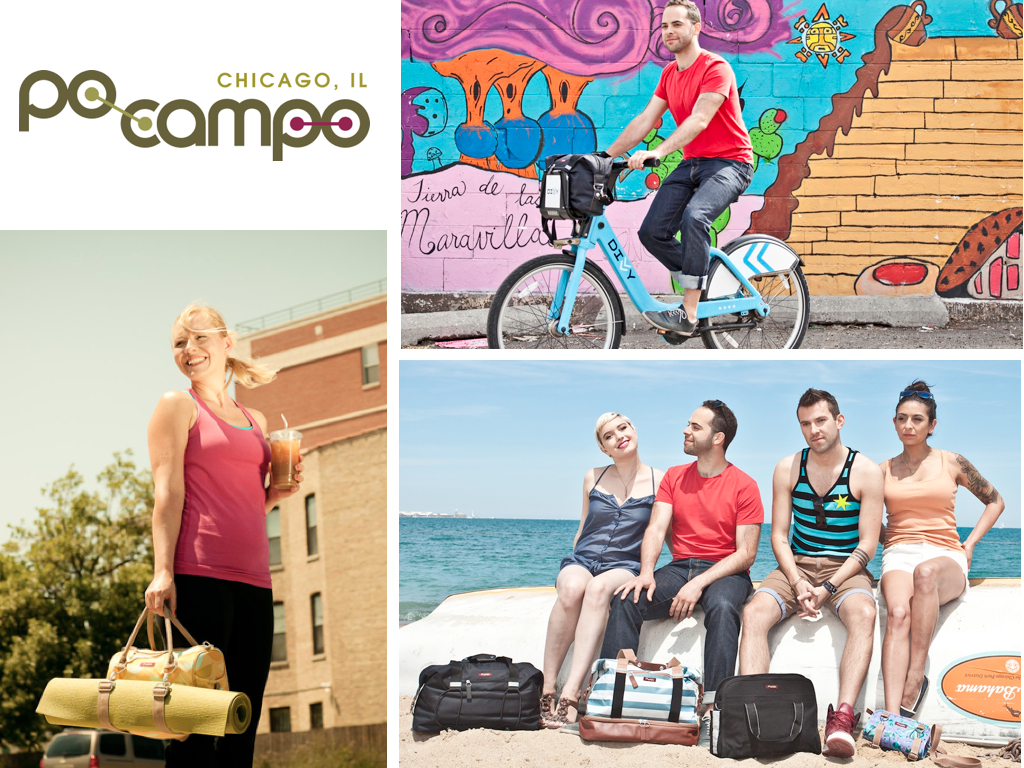
I launched my company Po Campo in 2009. We make bags for modern urban living: bike bags, yoga bags and travel bags. We sell our bags mostly through other retailers nationwide and internationally in Canada, Mexico, Europe and Australia, as well as through our online store.

There are lots of qualities that industrial designers typically possess that come in handy as an entrepreneur, particularly creativity, optimism and tenacity, because people are always going to be telling you that your idea isn’t going to work.

Yet there are other ways that I feel like my industrial design background has led me astray as I transitioned into the role of entrepreneur, which I’ll share through some anecdotes.
IDSAPresentation.003

I had two jobs before Po Campo. I graduated from the University of Illinois at Chicago in 2001 and wanted more than anything to become a design researcher. That was right after the first tech bubble burst though and jobs were hard to come by. I was thrilled to get a position at Arctic Zone, a Chicago-based manufacturer of soft coolers and lunch bags. That is where I learned cut-and-sew manufacturing and how to work with China.

Next I took a job at Webb deVlam, then called Webb Scarlett, as a structural packaging designer. In this role I learned about the power of branding, as well as the importance of standing apart from your competitors at shelf. Eventually I transitioned to heading Webb’s design research and design strategy department, focusing on helping our CPG customers identify white space in the market and learn what design language would communicate the desired benefits to the intended consumer.

Then I started to get the itch to do my own thing. As a consultant, I was working on projects for months that I cared deeply about, just to have them vanish with the final deliverable. I really craved holding onto the reigns longer. But doing what?
IDSAPresentation.004

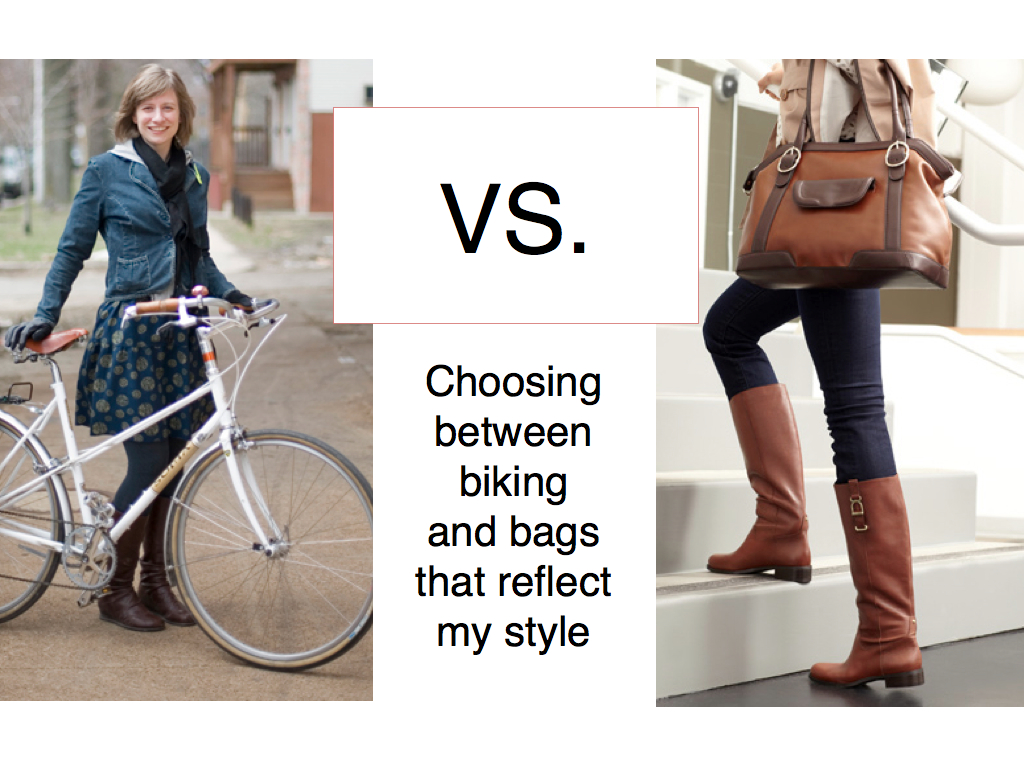
I always loved biking to work yet I wished there was a better way to carry my belongings. Backpacks and messenger bags didn’t do it for me and the bags that were designed to go onto bikes were very utilitarian. I felt like I was being made to choose between biking and having normal looks bags, which just seemed illogical.
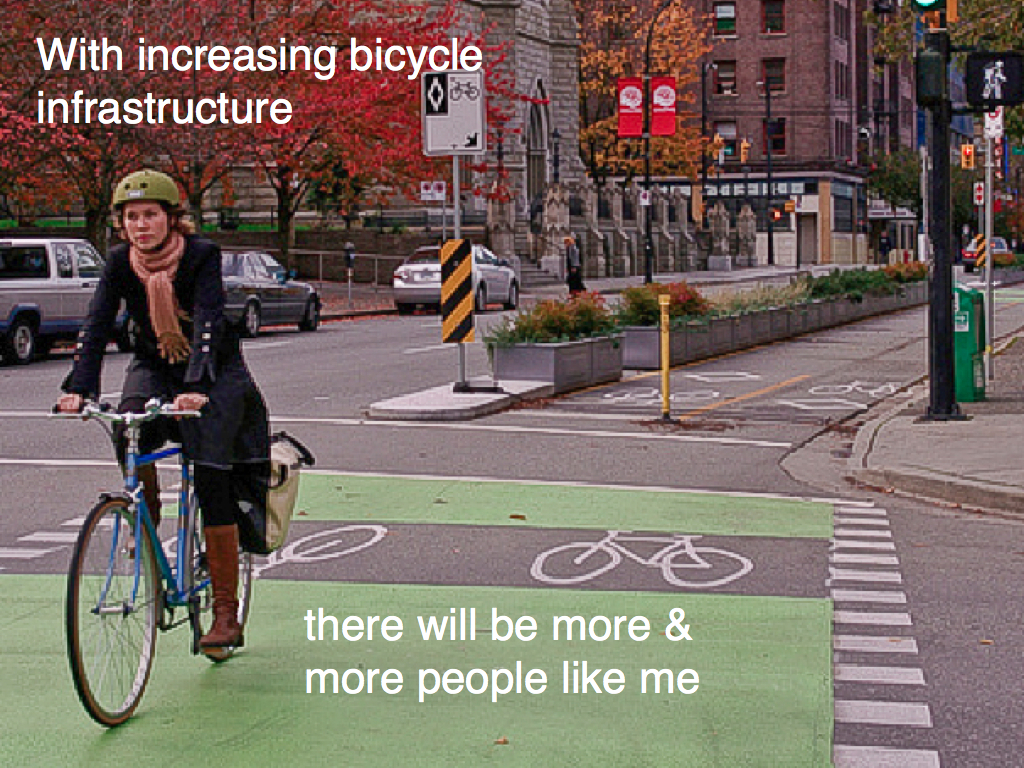
IDSAPresentation.005I realized that with my background in soft goods design and branding, starting a bike bag company would be a perfect fit for my talents. Plus, when I started doing my market research, I learned that cities around the world were investing a lot of money to build up more bicycle infrastructure to encourage people to bike for transportation. I knew there would be a lot more people like me, looking for crossover products to help them integrate biking into their daily lives. I could claim this emerging market space as my own. Easier said than done!
IDSAPresentation.006

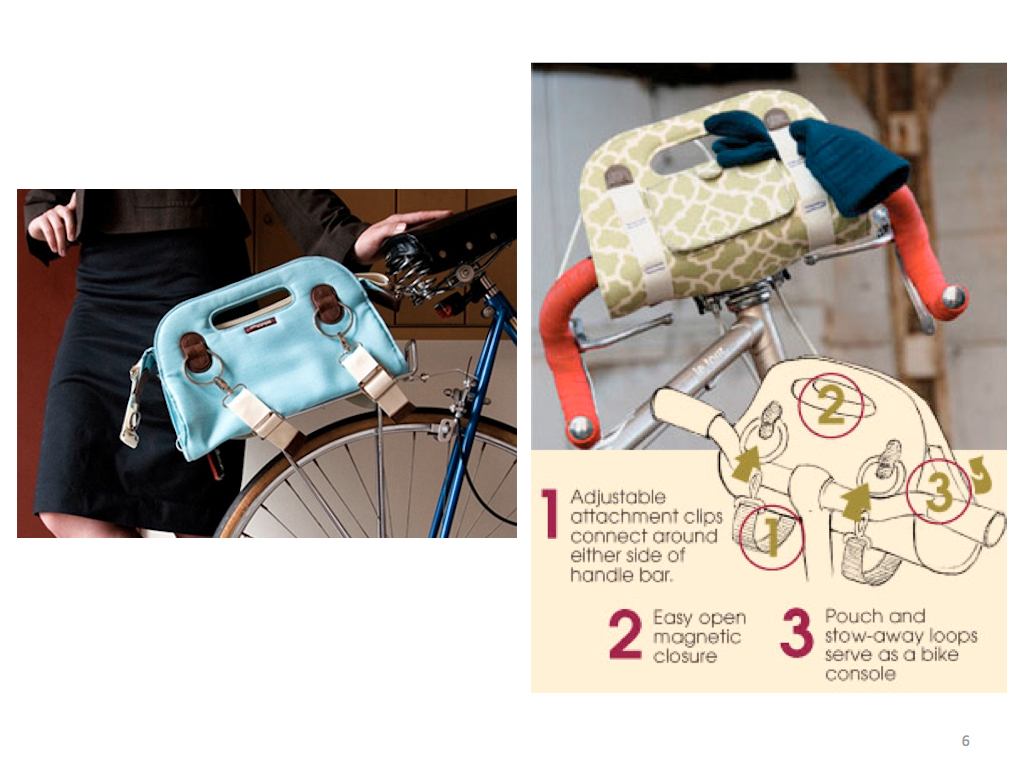
I teamed up with a industrial designer friend and these were the first two products we developed, a “Going to Work Bag” and a “Going Out Bag”.

In the beginning, I was so excited about building a company led by two female industrial designers. I really believed in the power of design and thought that it would give us a tremendous competitive advantage. I was convinced that, compared to most companies run by old businessmen, we would do everything differently and everything better.

It wasn’t until I had to start doing all the other jobs in the business that I realized how wrong I was about the importance of the design. Everything from shipping logistics to accounting to customer service had a spirit of creativity and craft to it, especially in the start-up phase where you are building the company brick-by-brick and figuring out how it all fits together as you go.
IDSAPresentation.007

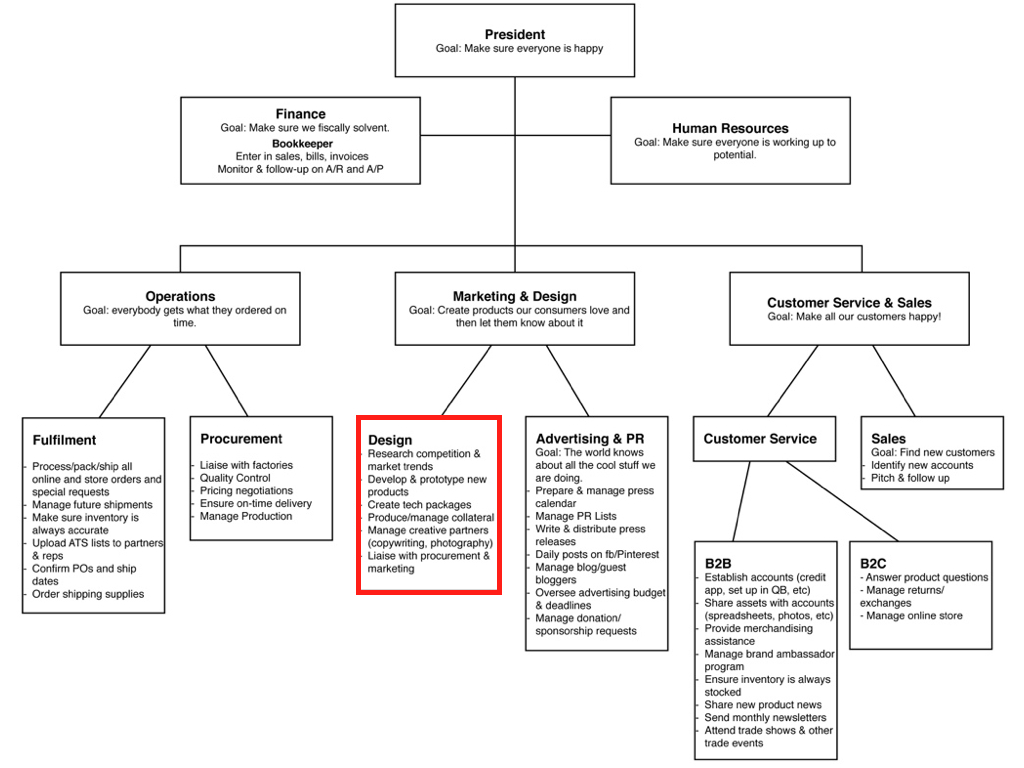
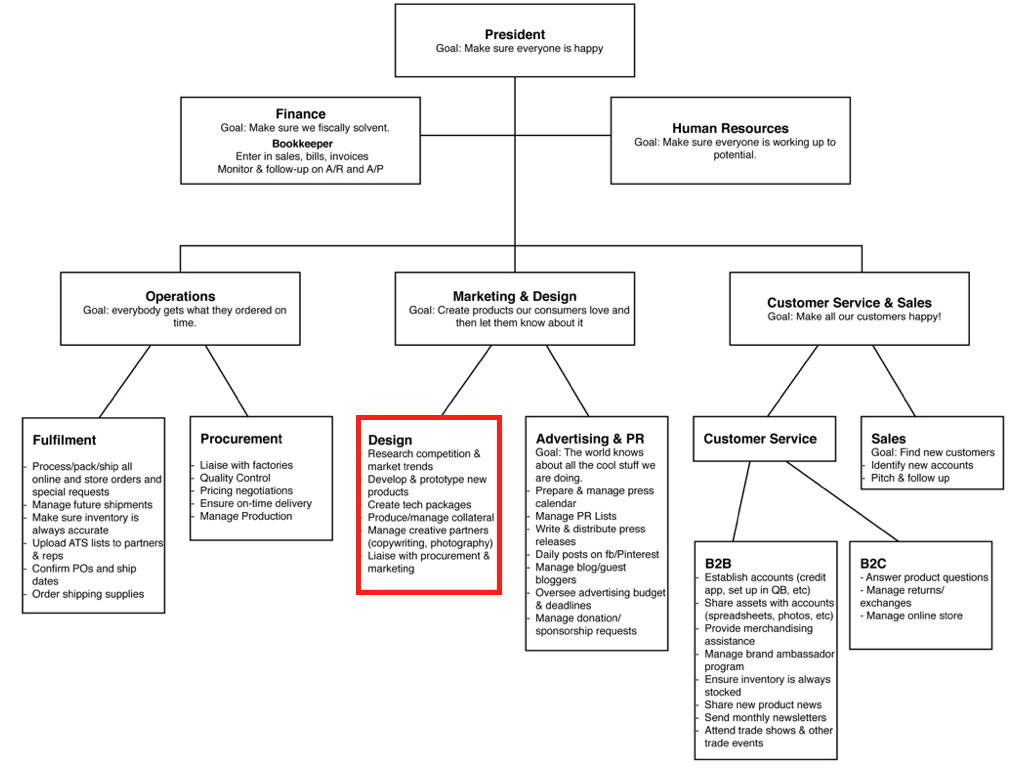
This is Po Campo organization chart. Learning the other jobs within a company really leveled the playing field for me, which is why you see Design at the bottom with everything else, instead of at the top where I first thought it would go.
IDSAPresentation.009

We launched in 2009, before Kickstarter and Shopify, so we went straight to selling in stores. I went door-to-door cold calling on shops. We got our bags into over 15 stores in Chicago that first summer and got great press right out of the gate. REI asked to bring in the line during our first month, and we soon had orders from Japanese and German distributors for our next season’s production run. Woo-hoo!

We started daydreaming about quitting our day jobs, about all the other great products we would develop, about what a cool studio space we would get. But that didn’t last long.

When I started calling our shops to get re-orders, I didn’t get any because they hadn’t sold any bags. After two and three months, they still hadn’t sold any, and would we mind taking them back? We panicked.

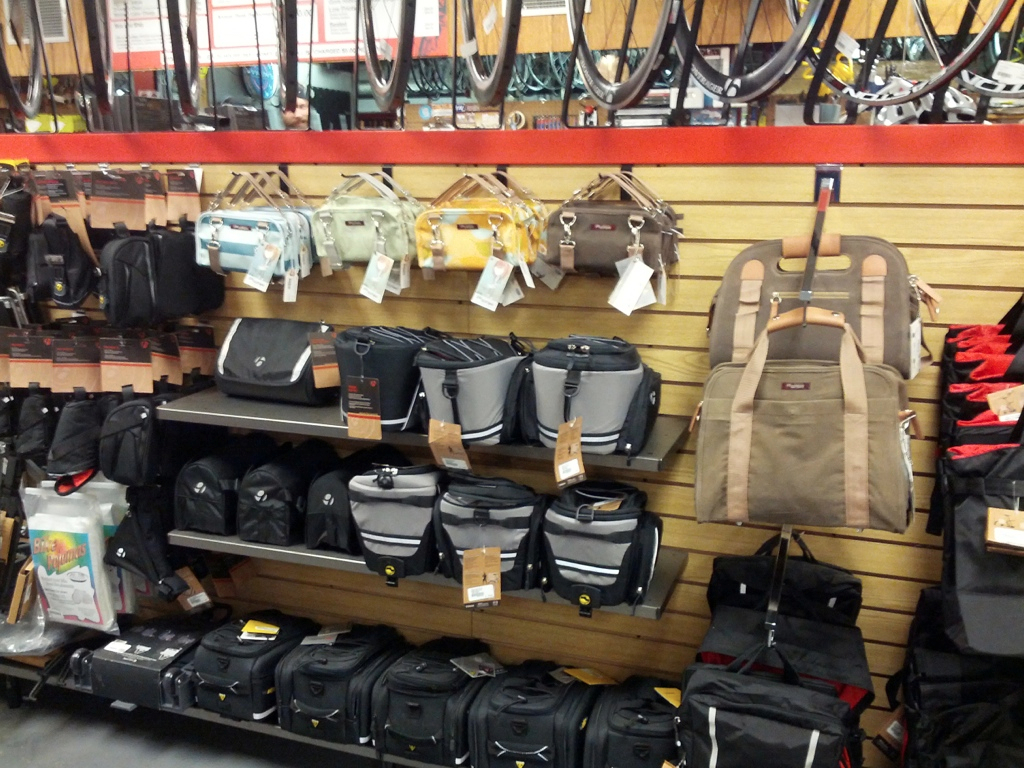
Looking back, I know what the two main problems were. First, our bags were about twice the price as the competition. Sure our bags were a lot cuter, as is evident in the photo above, but not THAT much cuter. Second, we were selling to an emerging market, which meant that our consumer not only did not know that products like ours were available, she didn’t even know that she needed a product like ours yet! We needed to do a lot more marketing that we hadn’t planned for.

Hindsight is always 20/20. At the time, we just felt like we needed to stop the leak and started asking our customers about what we could do to improve sell-through.
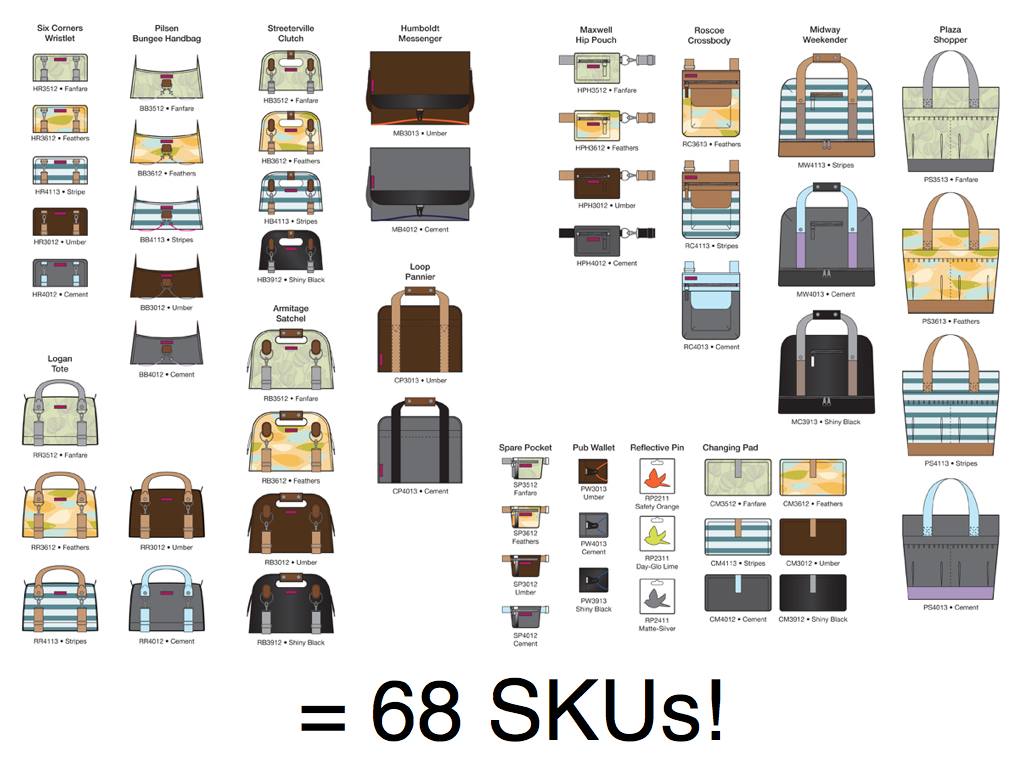
IDSAPresentation.010Most of the suggestions seemed like pretty simple fixes, such as streamlining the design to reduce cost, adding different sizes of bags, adding different colors, creating non-bike bags for people who like the look but don’t bike, etc. And here is where you have to be careful as a designer leading a company: Since design was the easiest thing for me to do, I just designed a lot more stuff. Our line ballooned from 6 SKUs to 68 SKUs just a few years later. Sure, we were growing, but it was haphazard growth that was hard to manage and almost certainly impossible to sustain.

So I went back to my design background and thought about what I would’ve said to a client who would’ve approached me with a similar situation back when I was a design strategy consultant. I would’ve told her to reconnect with her consumer, so that’s what I did.
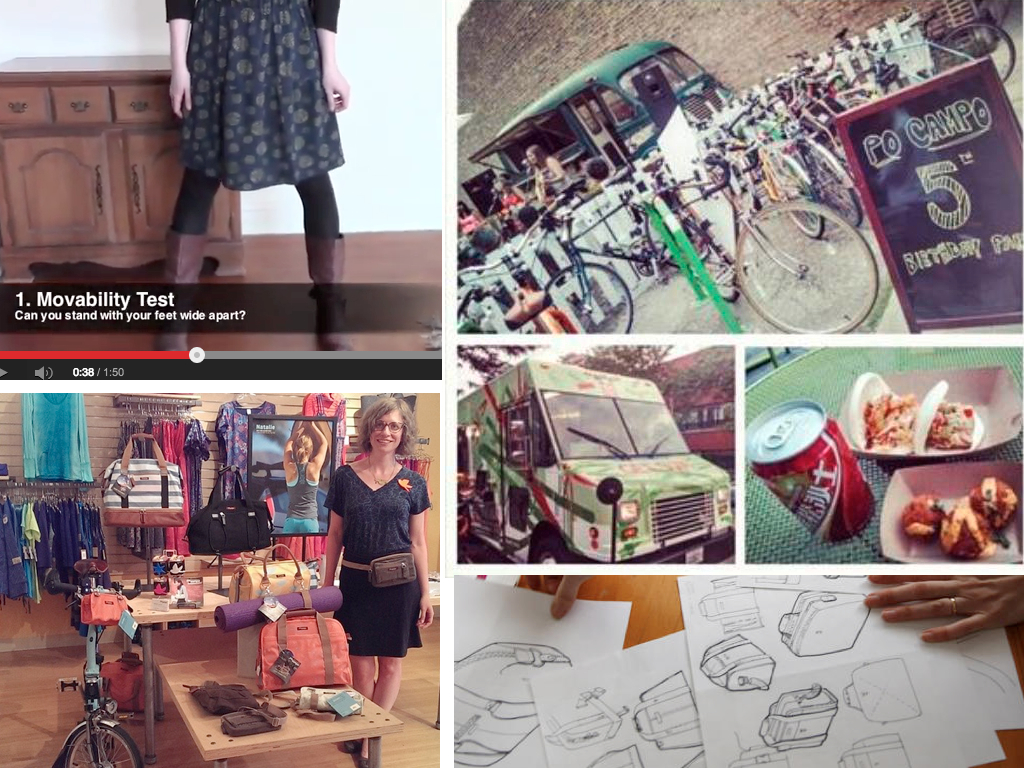
IDSAPresentation.011 We started spending time with our core consumer, identified which values we were aligning on, and refocused our line-up and marketing strategy around those values. We realized that we were not just making bags but building a community around the joy of modern urban living. We’ve started doing a lot more events, selected our retail partners a lot more carefully and started creating videos to show how people can incorporate biking into their daily lifestyles easier. Sales continue to grow – sustainably.

One of the biggest changes for me is learning to use numbers to understand what’s working in my business and what’s not, both for operations and design. Before Po Campo, I rarely used spreadsheets. Now data is my best bud.

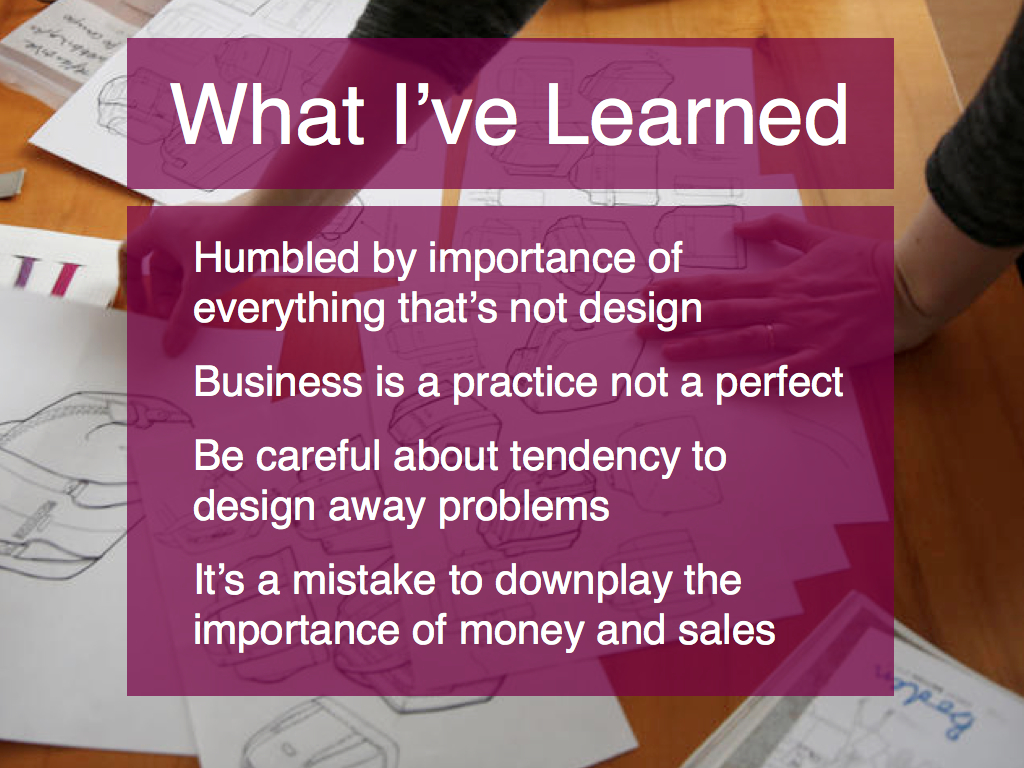
I always liked design research because it enables you to make a sincere connection with the people you are designing for and helps you see how the products you are designing will make people’s lives better. But making people’s lives better isn’t enough to sustain a business; you also need revenue & profit. It took me awhile to really internalize that.

The design community doesn’t talk about sales much, as if talking about money that a product makes diminishes its value. I think this is a mistake, as it makes us think that good design is above trivial matters of money, when it’s not.
IDSAPresentation.013

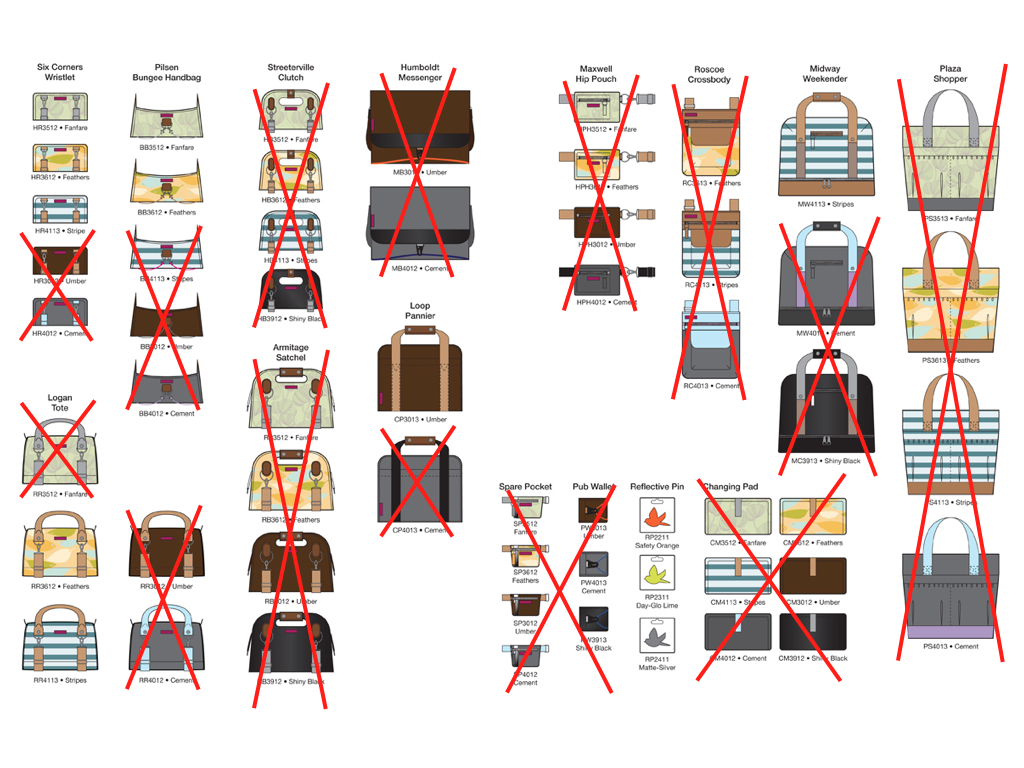
Part of the reason our line grew so big was that I got attached to the products that I want to have in market. I started my own company to make the products that I want in the world, so it is hard to kill them off. For products that didn’t sell well, I would always want to give them a second chance, thinking if I had marketed them differently, they would’ve sold better.

However, a bootstrapped company doesn’t really have the luxury to give products second chances. I’ve had to alter my definition of good design to be not just products that are made responsibly and meet a consumer need or desire, but also makes us money (preferably quickly and easily!).
IDSAPresentation.014 IDSAPresentation.015Thank you!

4 Tips for Surviving Trade Shows as an Introvert

I’ve found doing trade shows to be a necessary evil for growing Po Campo wholesale accounts. You get great exposure and there’s good potential for sales, yet they are expensive, time-consuming and exhausting – especially for introverts.

A key defining characteristic of introverts is that we refuel with alone time, whereas extroverts refuel by being around people. That means that the lucky extroverts get more and more energy as the day at a trade show wears on, while us unfortunate introverts are stumbling across the finish line by the time the show wraps.

Last week Po Campo was at its 10th trade show, the Outdoor Retailer trade show in Salt Lake City. With each show that we do, I hone my strategies for the best ways to survive them and get the most out of them. Here are my four tips for how to survive a trade show as an introvert:

1) Skip unnecessary social events (and don’t feel bad about it). People will tell you over and over that at the after show parties is where the real business gets done. Regardless, I know I am physically unable to work a 9 hour show and follow that up with mingling and drinking with strangers for another six hours, especially if I have to be back at the booth the following day at 9am at full strength. So I skip the parties. The difference this time around was that I didn’t feel bad about it. You have to know your limitations and respect them.
Side note: Often the industry parties right after the show have free food and drinks. If you’re like me and always looking to save a dime, go to the party just long enough to get a free dinner and then head out.

2) Plan your alone time to let yourself refuel. I used to think I could just muscle through a trade show, but inevitably I would run out of energy and ask a neighbor to watch my booth while I sat in a bathroom stall for 15 minutes to recharge. That’s no fun, so this time around, I planned ahead. I got up early to have a few hours of “Maria time” before showing up at the booth at 9am, enabling me to start the day fully charged and ready for action. I scheduled friends or sales reps to relieve me for 90 minutes every day at some point for a break. After the show, I would have dinner with a friend or go shopping for an hour or two before returning back home by 9pm to read or watch TV. Knowing when my escapes were helped me endure the longer stretches and be at my best for longer amounts of time.

3) Don’t talk to everyone. The common wisdom is that you should enthusiastically greet everyone that walks by and invite them into your booth to check out your wares. If you don’t act like this, people will tell you that you should. That’s simply not me, though, and nothing tires me out more than that kind of behavior. Instead, I smile at everyone I make eye contact with and if their eyes linger on my merchandise, I will jump into the pitch. If not, I don’t say anything. My reasoning is that I want to give the best version of myself to the people most likely to become customers and if I’m worn out from chatting with every person that walks by, that won’t happen.

4) Team up with an extrovert. Having an extrovert in the booth will relieve you of a ton of pressure to talk to people. Many extroverts actually like working at these types of events so finding a volunteer is pretty easy; I just post something on Facebook and offer a free bag in exchange for her time. However, be warned that if the show is slow, the extrovert will just talk to you instead, exposing you to the same small talk that you had hoped to escape. To play it safe, I usually only have my extrovert in the booth during the busy hours and then dismiss her when it quiets down, saying “I got it from here”. The busy times at trade shows seem to be between 10am – 3pm, although each show has its own rhythms.

If you’re an introvert, I would love to hear your strategies for surviving (and thriving) during trade shows. As Po Campo grows, I foresee more and more of them in the future, and there’s nothing I’d like more than looking forward to them rather than dreading them.

Book Review: #GIRLBOSS

The list of prominent female entrepreneurs in product and design businesses is short. Martha Stewart? Sara Blakely of Spanx?  And yet there is no shortage of tales of successful male entrepreneurs in these fields. While I find many of their stories interesting and informative, they too often end the same way: some dude kicking back with his millions of dollars, luxury watches and a fleet of sportscars. Yawn. Just because I want something else as my endgame does that mean my aspirations are any less important or my business acumen any less acute? No, of course not, but if you listen solely to these dudes, you might think so. If women define success differently than men, what is the female equivalent to this vision of “making it”?

#GIRLBOSS by Sophia Amoruso

I was thumbing through a copy of Sophia Amoruso‘s #GIRLBOSS in the bookstore and read the phrase “I stopped feeling like I didn’t belong anywhere, and realized that I actually belonged anywhere I wanted to be.” That sentence really struck a nerve with me. Here I had this idea for these great Po Campo bags that I was so excited about and passionate about and then for five years had to listen daily that they didn’t quite fit into the current marketplace and that it probably wasn’t going to work. When so many people tell you “probably not” for so long, and people that you respect, it takes awhile to build up the courage and turn that dialogue around and say, “Well, actually, yes it will!!” That’s kind of where I am now, which was why I was eager to read about how Amoruso made that transition herself.

First, #GIRLBOSS is not really a business book, even though it was in the business section of the bookstore and about her business Nasty Gal. Regardless it was certainly fun to read, as the writing style is distinctly her own and about as different from a normal business book as possible. In the book, she candidly talks about the qualities that she possesses that helped get her to where she is despite not having a college degree or even a prior office job. I think I would have absolutely adored this book when I was 17 years old, wanting to believe I had greatness in my future but not being able to imagine how a 17 year old pimply dork with no boyfriend could ever become great.

While I suspect my 17 year old self would be happy with where I am now, my 37 year old self craves more. Despite feeling like the book left me a little empty-handed as far as business lessons go, there was one meme in #GIRLBOSS that I’m taking with me, and that is that you have to believe in yourself whole-heartedly before you can ask other people to believe in you. That’s certainly not a new idea, but coming from Amoruso, a most unlikely powerful CEO, it really rang true and was incredibly persuasive. All those years of people doubting me (and me doubting myself) have definitely left their marks on my psyche, but Po Campo needs a thoroughly confident leader to attain its goals, so that is what I will be.

Savoring my design moments

Nowadays I identify more with “small business owner” than “industrial designer”. I’ve pretty much come to terms with that, although I still think “industrial designer” sounds cooler. Honestly though, I consider building Po Campo to be the ultimate design project, and that keeps me pretty satisfied.

Regardless, there are times when I get to return back to the simplicity of just thinking about design (in the traditional sense), and these are fun, blissful moments. One such occasion is working on our print patterns. I love coming up with the inspiration and building it into the larger Po Campo story.

This spring, we introduced our first proprietary bicycle print, which we are calling Bike Ride. We had originally intended to launch it for Fall 2013 and wanted to do something kind of wintery. In building our Pinterest inspiration board, Russia-esque images of furry hats and snowy palaces kept emerging, which got us thinking about Russian constructivism. The more we looked into it, the more inspiring it became.

pocampo_print

You can read more about how Russian constructivism influenced Bike Ride’s creation, from its role in industrial design history to its prominent female designers (a rarity then and now, sadly) in my recent post on Po Campo’s blog.

We are starting the journey again by working on a new print for Spring 2015. This, along with some new product designs, gives me a few days to be on a design vacation, which I cherish, before going back to the land of spreadsheets and sales presentations.

Everything is half-assed, and it’s okay

Being a scrappy, bootstrapped small business means that I can’t hire the pros to do the job right very often. I really struggle with this because I want everything that Po Campo does to be amazing.

In the past I would usually just say “f#@k it”, and hire the pros anyway, despite not being able to afford it. It’s just so hard to resist, because with the top-notch talent you know you will get a quality outcome with less oversight and in less time, and when your plate is too full and you want everything to be awesome, this seems like an obvious choice. And if everything you do is awesome, your business will grow that much faster, which means there will be more money, quicker. Right? Sadly, not in my experience.

Instead, I’ve learned that if you can’t afford it, that means that you will not have money down the road for other important things, like buying more inventory or paying your employees (or yourself). Clearly, this is not sustainable, which is why one of my goals this year is to ween myself off of this practice.

This decision means that I have to settle for the less than perfect version of some things, and just say “no” to many others. I have to decide what is “good enough”, which is a departure from thinking “only the best”. I don’t know if it is the designer in me or some kind of perfectionist inclination, but this is incredibly difficult.

I’ve opted for the cheaper versions of some things (lighter-weight paper in our catalogs for example) and postponed other projects that I know I want done right but can’t afford right now (like redoing our website). I made image templates so my team can generate their own brand visuals without having to pass things by me all the time. Are they awesome? No, but they get the job done and keep everything moving forward.

However, this resolution has already shown greater rewards than just saving money. It has given me a big confidence boost. See, I have learned pretty much everything about running a business while on the job and admit to always having doubted if we were doing everything “the right way”. Because of this insecurity, I was treating most of our business activities (everything from how to record orders to how to make forecasts) as stop-gap measures in place until we can afford to bring in a pro to kick things into high gear.

Now that I’ve said that we are not hiring anyone we can’t afford, for both contractors and employees, that puts the onus on me to confirm that we are doing things the right way, or, at least, doing things that are pointing us in the right direction. We’ve double-downed on writing processes for everything that we do to help us streamline it and identify ways to improve it ourselves. We agree on specific measurable goals and work together to figure out ways to meet them. I’ve come to appreciate that it isn’t so much about getting to a point where you can hire the best people, but it’s about building something brick-by-brick with good people. 

Saying that we are doing everything “half-assed” isn’t quite right, because that implies that we don’t care. Instead, we’re trying our best, with a full heart, and believing that we’ll get there eventually.

How to Increase Online Sales: Part 1

Every year I say I want to increase our online sales because, like all manufacturers, we make mad margins on products sold through our online store, which in turn improves our cash flow and bottom line. While our online sales have grown steadily year after year, for 2014, I intend to make a concerted effort to grow them more aggressively. How will I do that? Good question! I’m not entirely sure but thought I could use this blog as a way to share my journey as I go and hopefully help you shortcut the process.

So, for some background info, my goal is to increase our online sales by about 38% to cover the majority of our overhead expenses. It seems ambitious, but I believe it is doable if I put a solid plan together of how that will happen. 

Basic business education tells us that there are generally three ways to increase sales:

  1. Sell more to existing customers
  2. Find new customers
  3. Raise prices (or decrease costs)

I want to consider working on all three things but we need to do some research first.

How do we get our sales today?
My first thought is to try and understand what’s been working so far. I generate the “Sales by Traffic Source” report from Shopify (our e-commerce platform) for 2013 to see where most of our purchasers are coming from and find out that the vast majority of traffic comes from pocampo.com, meaning most people go to our homepage before clicking into the store. Not terribly insightful. Next, I go to Google Analytics to dig deeper into how people end up on our homepage. (Disclaimer: I am definitely a Google Analytics novice, which means you may find better information elsewhere. However, being an entrepreneur means you spend time everyday figuring out something new, which is what I’m doing here)

Since I’m most interested in sales, I go to the conversions menu first, expand “Ecommerce” and check out our conversion rate and average order value, among other things. I plan to use these values for benchmarking our progress as we grow. Next, I click on “Time to Purchase”, also under Ecommerce. Here I find out that 88% of our visitors are purchasing on the same day that they are coming to our site and that 81% are purchasing on their first visit! This suggests to me that when people come to our site, they have already decided that they want to buy.  To confirm that, I then opened up “Multi-Channel Funnels” and peek at “Path Length”. Yep, 70% of conversions have only one path, meaning the purchaser only clicked on one thing before coming to our store to buy, or just plain typed our URL into their browser window. While I like the thought of people exploring us on the web by searching through Google or whatnot, that apparently is not happening. 

I’m curious what the first (and only) path is, so next I go to Acquisition>Channels and change the Conversions option to “Ecommerce”. Here I learn that Google is responsible for about 22% of both my traffic and online sales. The direct channel, most likely meaning people typing our URL directly into their browser, accounts for 19% of traffic and 27% of sales. Facebook comes in third place with 4% of traffic and 2% of sales. Our Mailchimp newsletter shows up towards the bottom of the list which surprises me because it seems like we always get a bunch of orders whenever we send out a newsletter. I suspect that some of the direct sales are from these newsletters and make a note to check our Mailchimp settings to make sure clicks are being tracked properly.

It’s now obvious that people have already decided that they want to buy a bag from us by the time they come to our site and that they are coming to our site from Google or just directly. If from Google, what words are they searching to find us? I go to Acquisition>Keywords>Organic to find out. Most are irksomely not provided, but there are a lot of variations of our brand name. So even if our consumers come to our website from Google, they already knew that they want Po Campo!

Okay, so it’s clear that people who purchase from our online store come to our website with the intent to buy and don’t dilly-dally. But do they come knowing which bag they want to buy, or do they just know they want a Po Campo bag and browse around a little first? To find out, I go to Audience>Overview and see that most visitors see about four of our pages before leaving. That hints at a little browsing and I’m interested which four pages people are going to most often, as well as the sequence of those pages. In Behavior>Behavior Flow, I sort by “Converters” and see that half of all traffic visits our homepage first. After that, most people go to the Bike Bags category, then to a specific bag, then to Cart. Sometimes after that third step, they go back and look at a different bag or look at a video. However, it does seem that people are coming to the site with a specific bag in mind.

Lesson 1: Our current customers know Po Campo well
Based on my first go at Google Analytics research, it seems safe to say that our sales are coming from people already very familiar with Po Campo. Therefore, it seems the best place to start is to figure out how to sell more to our current customers. See Part 2 for that.

Did I make any mistakes in my usage of Google Analytics? Set me straight in the comments below.

Understanding your financial statements: Overview

I frequently meet with budding consumer products entrepreneurs who ask me questions about finding suppliers or talking to stores or getting press. Rarely does anyone ask me to help them understand their financial statements. And by rarely, I mean never.

As industrial designers, learning how to use financial statements to guide business decisions is just not a competency of ours. Financial statements are emotionless, brutally so. They lack nuance. They reduce the richness of our work to heartless black-and-white numbers. Moreover, we fear that the numbers will tell us to stop doing something when we know in our heart of hearts is the right thing to do, even if it isn’t making much money (yet).

Envisioning the future comes easily to me and is enjoyable, while addressing reality can be tiresome. As a business owner, you must be able to do both, and the objectivity of financial statements makes them useful for evaluating the “reality” piece of the equation.

The three main financial statements are:

  • Profit & Loss Statement (also called Income Statement)
  • Balance Sheet
  • Cash Flow Projections

I’ll devote individual blog posts to these different statement types, but here’s a quick overview of why you should care about each one, with a relatable example to illustrate how they work together.

Profit & Loss Statement (P&L)
I think this is the easiest one to mentally grasp. Basically, it takes your sales and subtracts your Cost of Goods and overhead expenses, leaving you with your net profit.
Why a P&L is useful: If your net profit is a negative number, you’re losing money, which is unsustainable.

Let’s say you graduated college and got a decent job that pays $4,000/month.Your monthly expenses are $3,000/mo., giving you an extra $1,000/mo of “net profit”. If you were spending more than you were making each month, you’d have to borrow money from mom & dad or use credit cards to keep going, neither of which is desirable for very long.

Balance Sheet
I think of the Balance Sheet as describing the overall “health” of your company. It summarizes your assets (things you own, like cold cash or inventory) and liabilities (things you owe, like loans).
Why a Balance Sheet is useful: The Balance Sheet shows you if you are healthy through and through or if you are actually sickly but clean up nice. If you are carrying a lot of liabilities, such as loans, you are being weighed down by debt, even if you are showing a profit on the P&L.

In our scenario from above, I forgot to mention that you have a $50,000 school loan debt and $10,000 in credit card debt. So, despite making a $12,000 “profit” each year, you are still in the red overall since you owe $60,000 to other people. The debts don’t show up on the P&L, so you need the Balance Sheet to get the full picture.

Cash Flow Statement
As a small company, your vendors are going to want you to pay upfront and your customers are going to want to pay you late. That means that even if you show a profit when all is said and done, there will still be times when you don’t have the money you need to pay the bills just because of timing.

Why the Cash Flow Statement is useful: If you look at your statement and see that things are going to be tight in, say, March, you can plan for it by asking for better payment terms from certain vendors or delaying purchases.

In our real-world example, this would be like deciding to use $4,000 of your annual $12,000 “profit” to book an awesome vacation for you and a significant other in February. At the end of the year, you will still have $8,000 profit leftover, but February will be tough since you still have to pay your normal living expenses.


This took me a couple of years to wrap my head around, but I think it would have been useful to internalize them earlier. Please leave questions in the comments below and I will answer to the best of my ability!

Creating my business in my own image

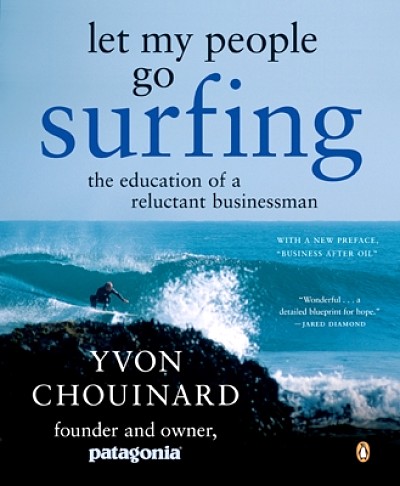
let-my-people-go-surfingI recently read “Let My People Go Surfing: The Education of a Reluctant Businessman” by Patagonia founder Yvon Chouinard. There were many parts of the book that I found inspirational and informative, but perhaps the lesson that stuck with me most was how strongly he carried his values through to his company. Of course this includes the company’s famous environmental policies, but also how the company manages its finances, the relationships it builds with its customers, the benefits it provides its employees and on and on. Sure, some aspects of Patagonia’s culture may not be as close to his heart as others, but it is clear that he built Patagonia to be an extension of the things that he cares about through and through.

Then, today I read an interview with Cadence Dubus, who owns the Pilates studio Brooklyn Strength. In explaining her commitment to creating an eco-friendly space, she says, “If you’re going so far as to open your own business, that is such a statement about your beliefs. I would hope that every aspect of that would be as close to my values as possible”.

This really struck a chord with me because it acknowledged that starting a business requires a lot of courage and commitment and you don’t just do it willy nilly. But, strangely, I never thought about how the business you start is an automatic reflection of yourself. Why did this seemingly obvious thing never occur to me? Maybe because the start-ups you read about nowadays are high-growth tech companies intended to be sold as quick as possible, thus having a fingerprint of the founder is not necessary, if not undesirable. Or maybe it is because I always pictured Po Campo living on beyond my involvement, in which case I would not want the whole operation to lose its sense of identity without its founder. Possibly it is because I started Po Campo with a dear friend, and since it was “ours” it could never be “mine”, or “me”.

Regardless of the reason why I never thought about how my personal values should be shared with my company, my new “flex time” policy showed me why it is important. Declaring that no one has to come in to work when they don’t want to as long as they get their work done was my biggest managerial statement to date. And experiencing the freedom of not having to come in to work every day is incredibly liberating and joyful to me. I finally saw for the first time just how cool Po Campo could be. Po Campo can become my dream company to work for, and for others who share a similar idea of how a dream company should behave.

Sure, there are certainly other aspects of myself that the company has already assumed, like a persistent frugality, a certain mellowness, a respectful position towards others. But now I’m thinking of things that I always thought that we would do later when we had more time or money, like recycling or volunteer work or decorating, but now I am thinking we should just do it now. Those things are important to me, would be a part of my dream company, so what am I waiting for? I want to start working at my dream company today.

I’m a cobbler and my children have no shoes

My background is in design research and design/brand strategy. I believe in the importance and power of these disciplines. Yet, for my own business, I rarely do either. What the heck?!!?

Since acknowledging that the adage about the cobbler’s children without any shoes applies to me, I googled the expression to find out how I turned out like this.

A couple of theories of why this happens:

  1. Externally Motivated. Is my drive to please others stronger than my drive to just do high quality work? It’s a possible explanation as to why I conducted proper research for my clients and just do minimal internet research for myself. With the former, I would have an audience gathered around a big conference room table to listen to my every word and congratulate me on what a good job I did. With the latter, I have to wait months to see if my conclusions from the research were correct and, even if they are, there is still no one to pat me on the back. I never knew that praise was important to me, but it is.
  2. Limited Resources. Whether money, time or talent, you’ve only got so much of each. Whenever someone would suggest that I do research, I would say, “But I don’t have time!” even though I knew that research doesn’t have to take a lot of time or money. So, while this may be true for others, for me it was just an excuse.
  3. Lack of Confidence. I never received proper training or education for design research and strategy. I developed my methods myself based largely on intuition and what seemed to work in the field. Interestingly, I felt like that sufficed when working with clients but fills me with doubt when working on my own business. The stakes certainly seem higher now, so maybe just going with my gut doesn’t give me enough confidence?

Obviously, these are all rather lame excuses for not doing something that is incredibly important. Doing my first bit of consumer research this past week, albeit a very small bit, was a good confidence re-builder. It forced me to acknowledge that there are things about my consumer that I do not know and that I can use my old research methods to start to figure them out. I’m looking forward to doing more in the future.

Any other examples from other entrepreneurs out there that found themselves neglecting their specialty in running their own business?

How I ended up with too many SKUs

If you read my post yesterday about how there are too many Po Campo products in my line, you might be wondering how I found myself in this predicament. I was wondering the same thing! Upon introspection, I believe this is how I get to a point where I have 40 SKUs in a business four years old with a hard time retaining customers:
  1. I like designing bags. I would design a new bag every day if I could. I would introduce a new bag every month if I could. It’s fun!
    Lesson: It takes a lot of money and time to support every SKU. I’m seriously lacking in both so these so having the freedom to design my brains out will be something to shoot for: grow the business so there is enough $ and manpower to support that activity. Until then – stop it.
  2. Women like to have options. This is pretty well documented and the reason I would tell myself that designing so many bags was a good thing. Again, I’m too small to have the options that Fossil and Le Sportsac have.
    Lesson: Have patience and wait until you’re closer to being a multimillion dollar company before you start acting like one.
  3. I was reactionary. A customer would say, “Oh, if you had this or that bag, I would buy it.” I would think, “Oh – that’s a good idea!” and would design this or that bag. And said customer would order 8 of them and I would be stuck with marketing the other 292.
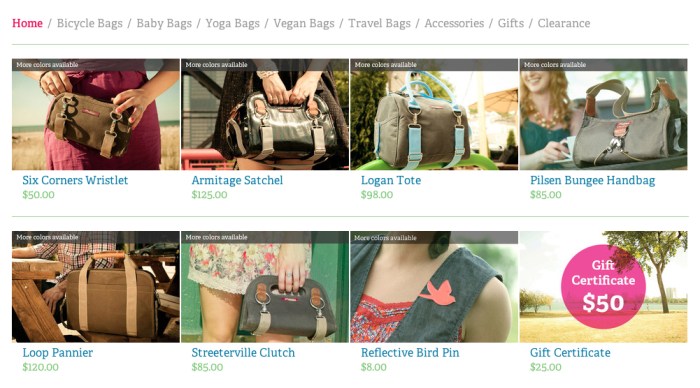
    Lesson: Only design this or that if they are going to order at least 500 of them.Homepage
  4. I was chasing instead of leading. Po Campo started off with two bags (the Clutch and the Satchel) and sales were “meh”. In using the bags ourselves and talking to others, the consensus was that neither were good for “everyday” use. The clutch was way too small and the Satchel was too big. So we did an in-between-sized bag, the Pilsen Bungee. Sales continued to be “meh” so we did some more digging and learned that the price was too high. So, the Wristlet and Logan Tote were introduced as cost-reduced versions of the other bags. Sales continued to be “meh”. You get the idea. Pattern is too polarizing? What about these? Bags are too feminine? Let’s try this. Function is too complicated? How about this? Before I knew it, I had 40 SKUs to support.
  5. Lesson: Going forward, I am going to take all of those requests but stop throwing darts at the wall to see what sticks. I am going to choose my best darts and stand a foot from the wall to make sure they stick.
All along, the real problem was that the bags weren’t selling well in stores. I should be able to solve this with a few SKUs, and then go from there. Wish me luck!